Showing posts with label community. Show all posts

Tuesday, 1 April 2014

Dial H for History

Tideswell Living History Group will launch the Tideswell History Telephone on Friday 11th April. This is the first time an unused iconic red telephone kiosk still in its original location has been turned into a permanent oral history audio heritage centre. 

Residents and visitors will be able to dial-the-past to listen to Tideswell folk talking about village history using a specially adapted and free pay phone. The kiosk will also feature a gallery of archive photographs about the village. The rear of the kiosk will feature a specially written poem about using the phone to communicate in the days before mobiles and Twitter. The poem, called ‘An Ode T’ T’owd Phone Box’, was written by Dave Greenan and was the winner of a poetry competition in 2013.

The oral history recordings and photographs have been collected by members of the living history group over the last two years as part of the Tideswell Tales project. This is a community-led history project supported by the Heritage Lottery Fund and co-produed with inHeritage. We came up with the idea, liaised with Blackbox AV who supplied the unit, edited the audio and advised the group during the process of creating the 'heritage centre in a box'. The Peak District National Park Authority has paid for the cost of refurbishing and cleaning the box through the Sustainable Development Fund.

Judy Cooke, Vice Chair of Tideswell Living History Group said "Funding has helped us to preserve the distinctive telephone kiosk in its original position in Fountain Square after the Parish Council bought it from BT for £1. In the days before mobile phones and before most people had landlines, this was one of the lifelines for residents to communicate in emergencies or get in touch with friends and family. The box is in a central location and has been part of Tideswell life for generations, with many stories to tell. It has been transformed to tell many more. We hope it will help residents rediscover their past and visitors to learn about the people's history of Tideswell."

All calls are free and you can’t dial 999 for emergency services! Oral history and photographic displays will be changed regularly from the large archive collected by the group. You can also explore more of the archive by visiting http://tideswelltales.wordpress.com.

The launch takes place on Friday April 11th at 12pm. Local historian Tony Hill will unveil the box. There will be free tea, coffee and biscuits along with a display of more photos in the Vestry of Fountain Square Church.

About Tideswell Living History Group 
We are a group of people living in Tideswell and Litton, Derbyshire who wish to preserve our recent past through memories, photographs, anecdotes, news stories and other sources.

About the Heritage Lottery Fund
Using money raised through the National Lottery, the Heritage Lottery Fund (HLF) aims to make a lasting difference for heritage, people and communities across the UK and help build a resilient heritage economy. From museums, parks and historic places to archaeology, natural environment and cultural traditions, we invest in every part of our diverse heritage. HLF has supported almost 36,500 projects with more than £6bn across the UK.  www.hlf.org.uk.

Sunday, 17 March 2013

Walkley Memories Day


Thank you to everyone who came to and helped make the Walkley Memories Day such a resounding success on Friday afternoon.

Walkley Community Centre was abuzz with residents and ex-residents sharing their memories, photos and documents of Walkley's rich history. Ruskin Hall looked splendid with tables, each with plates of biscuits, scattered around the room.


Over 65 people came along between 2pm and 5pm, while 21 volunteers welcomed and talked to visitors, scanned photos and documents, and helped serve tea and coffee. There was also a slideshow of old images collected by the project so far and an exhibition. Some visitors went upstairs to look at the Reform Club World War 1 memorials in the snooker room.

We found out about all aspects of Walkley's history, from World War 1 to the 1970s, and saw an original letter written home from the First World War trenches by one brother to another.


Volunteers worked tirelessly to record recollections, with two people kept very busy on the photo scanner that luckily bounces. One lucky person now has the task of putting the names and details on a list so we can begin contacting those people who have asked to be recorded.

Sunday, 3 March 2013

Hope - Castleton Finds Day

Today was another successful finds day for the Hope and Castleton Lives of the Medieval Common People project.

Ninety people came to see the finds from 50 test pits dug in the Derbyshire villages in 2012.

Thursday, 28 February 2013

Walkley History update


Great night with the Walkley historians last night. Seventeen people gathered around tables in Walkley Community Centre with maps, documents and photos to decide who is going to research what from the lives of WW1 soldiers through the early years of Walkley Reform Club to post-war life, slum clearance and the Walkley Action Group campaign.

Then, we followed the historian session with the second of two oral history training workshops at the Centre. There are now 21 trained oral historians ready to hit the streets of Walkley to discover its remembered past! Some will begin recording family, friends and neghbours. We also have about 30 people who have been in touch asking to be recorded.

Today, we spent an hour with Veronica Hardstaff in Ruskin Park, identifying which demolished streets local school children will mark out across the park for the Walkley Festival’s Ruskin Park Fun Day on the 6th July. The even numbers of Harworth Steet are definitely on to do, including the club at the corner with Daniel Hill St.

Some of the stalls will be in people’s houses, hopefully the beer tent in a back garden and the stage in the club.

We will write potted biographies of families from as many demolished homes as we can, with names and occupations, display photos and produce a discovery trail for families.

Friday, 27 April 2012

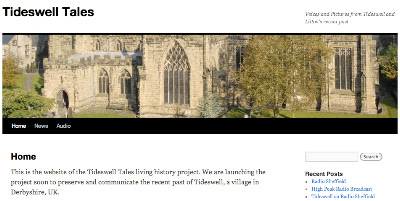
Tideswell Tales Website

The Tideswell Tales website is launched today.


Bill led a training workshop on using the free website service wordpress.com to promote and communicate the Tideswell Tales project to members of the Tideswell Living History Group. He taught participants how to add and edit pages, blog posts, media files and photographs - including how to create image galleries. We also went through how to upload audio files to AudioBoo and SoundCloud, then how to embed the audio files into Wordpress pages. The members of the groups created news pages with embedded radio broadcasts and new themed sections with pages containing oral history recordings.

Using social media audio services saves expensive media hosting fees and embeds excellent, easy-to-use media players into project and society websites. Wordpress allows societies to create free function-rich websites containing news, events, information, photographs, documents, PDFs, and embedded audio and video, which are easy to maintain with a little training.

You can listen to the project launch radio interviews and the first oral history excerpts at Tideswell Tales. Click on News or use the drop-down menus under Audio.


Wednesday, 25 April 2012

Oral History Training

Tideswell Living History Group at the oral history training workshop

The oral history training workshops for both the Calver Weir and Tideswell Tales oral history projects have been a great success. inHeritage brought in Colin Hyde of the East Midlands Oral History Archive to lead both sessions. The Tideswell workshop was held in the Tideswell School of Food, made famous by the BBC's Village SOS series.

The potential interviewers of both projects gained a lot from them and reported very positive feedback. Brilliant, fantastic, excellent were all used to describe the sessions. The sessions showcased good oral history projects, then went through interview techniques, using audio recorders, ethics, consents and archiving. Each participant had the chance to interview someone else in the group.

All the participants now feel that their projects are really underway and ready to carry out their first interviews.

Colin is just one of a number of Heritage Lottery Fund and Oral History Society approved oral history trainers from around the country we can supply for groups and societies beginning their own projects.

Colin Hyde

Tuesday, 27 March 2012

Calver Weir Memories Day


Today was the first public event of the Calver Weir Oral History project. Bill facilitated a memories day in Calver village which brought together the volunteers and participants willing to share memories, photos or other info about Calver Mill, its Weir and the River Derwent nearby.

The village Methodist Hall resounded to stories about stainless steel kitchen sinks, boyhood games along the river and the mill's appearance in the BBC series Colditz. Colleagues who worked at W & G Sissons, occupants of the mill for much of the second half of the 20th century were reunited after many years, including the Sales Director and his secretary.

Volunteers gained their first experience of collection memories - and of scanning documents. The Chair of the Calver Weir Restoration Project was later interviewed live on BBC Radio Sheffield.

We now have almost 20 people who wish to be interviewed or have other historical information they are willing to share.

Thursday, 16 February 2012

Hope-Castleton Lichfield Archives Training


Fifteen members of Hope and Castleton Historical Societies, along with other volunteers from the Hope Valley and Sheffield, begin discovering Hope and Castleton's Medieval past in Lichfield Archives.

Andrew George, Principal Archivist, gave an clear and enjoyable introduction to the types of records available. Both villages were part of the Medieval Diocese of Lichfield, therefore a wealth of ecclesiastical records are stored in the Archives. There are wills, inventories, Bishop's Registers, charters and a range of other documents which give an insight into Medieval life in Castleton and Hope.

The group left the excellent training day enthused and buzzing - both with what they discovered on the day and the potential to come.

The Hope-Castleton Medieval Common People project is one of a number of ongoing projects managed by inHeritage. Please see our projects page for those we have completed.


Monday, 23 January 2012

Hunter Archaeological Society Centenary

inHeritage will be working with the Hunter Archaeological Society to celebrate their centenary in 2012.

The Society has a rich history of researching and conserving the archaeology and historic buildings of South Yorkshire and North Derbyshire. Over the Society's 100 years they have taken part in notable projects, including the 1930s watching brief on Sheffield Castle, and the 1970s excavations of Swine Sty prehistoric settlement in the Peak District.

During 2012, inHeritage will help project manage a range of activities designed to celebrate the Society and the importance of community archaeology. We will lead workshops on interpretive writing and exhibition production, as well as assist society members write and edit a booklet and exhibition. We will produce a free-to-use Google Sites website for the Society, the first dedicated website the Society will have, and train members in its maintenance. The new web address for the Society is - www.hunterarchaeologicalsociety.org.uk

The press release for the project is below:

Hunter Archaeological Society wins Heritage Lottery Fund support
The Hunter Archaeological Society has received £36,500 from the Heritage Lottery Fund (HLF) for an exciting project in South Yorkshire and North Derbyshire: Lives in the past, discoverers for the future. Led by volunteers from the local community, the project will celebrate 100 years of community involvement in historic and archaeological research and conservation.
The project will inspire and train a new generation of ‘heritage explorers’ to continue this long tradition of amateur involvement in archaeology. The project will form part of the centenary celebrations of the Hunter Archaeological Society, a charitable society set up in 1912 to study and report on the archaeology, history and architecture of South Yorkshire and North Derbyshire. The Society is named after Joseph Hunter, one of the first people to research and record the region’s history. Joseph was born to a cutler in Sheffield in 1783.
Ruth Morgan, Honorary Secretary of the Hunter Archaeological Society says “We’re very grateful to the Heritage Lottery Fund who have awarded the Society a grant to celebrate the contributions that individuals and communities have made to the discovery of the heritage of our region. We are looking forward to telling more people about the Society during this important year in our own history.”
The Society is organising a series of events during the year with the assistance of the University of Sheffield, Sheffield Local Studies Library and Museums Sheffield. These include a Centenary Weekend, 11th - 13th May, with a conference on community archaeology, a reception at Sheffield Town Hall and dinner at the Cutlers’ Hall. The weekend launches a series of guided walks and excursions throughout the summer -these will be available later as self-guided trails, and there will be a special edition of the Society’s Transactions.
Weston Park Museum will host an exhibition on the work of the Society from February. Members are researching the life stories of past members and these will feature in an exhibition in Sheffield University Library in the autumn and a specially produced booklet.
Primary schools in Barnsley, Sheffield and Dronfield will take part in a project which includes digging test pits to get hands-on experience of archaeology.
You can find out more about the events and the Society at www.hunterarchaeologicalsociety.org.uk
Fiona Spiers, Head of HLF, Yorkshire and the Humber said “This is a fantastic project which will allow the community to learn about the Hunter Archaeological Society and the contribution it has made to their local heritage. Through aprogramme of hands-on events and activities focusing on archaeology and community history, people of all ages will have the opportunity to learn new skills and get involved in the heritage that matters to them.”
ENDS

Monday, 16 January 2012

Hope Castleton Medieval People

Hope and Castleton Historical Societies have been awarded a Heritage Lottery Fund grant to learn about the ordinary medieval people of the two villages in Derbyshire.

inHeritage will be working with the societies to facilitate the project. We will help manage the project, provide skills in landscape archaeology, historical and interpretive writing, booklet production and graphic design.

The press release is below:


Hope and Castleton Historical Societies win Heritage Lottery Fund support

Today, Hope and Castleton Historical Societies have received £26,000 from the Heritage Lottery Fund (HLF) for an exciting project, Digging Hope and Castleton’s Medieval History, in Castleton and Hope. Led by volunteers from the local community, the project aims to discover where the common people lived during the medieval period. The two societies are working together between now and March 2013 – and they need your help.

The project will try to find out about the ‘hidden history’ of Castleton and Hope villages between the Norman Conquest of 1066 and the Civil War in 1642. While history can often tell us about kings, lords and landowners, it is more difficult to track down the ordinary people who lived and worked in the Peak District’s villages. This is because they don’t appear in as many historical documents, most of which are about property, and their history can remain hidden.

Di Curtis of Hope Historical Society says “We are grateful to the Heritage Lottery Fund who have awarded the Society a grant to look into the medieval history of Hope and Castleton. This means we can undertake documentary research, dig archaeological test pits and survey the old routes between the two villages.”

Angela Darlington of Castleton Historical Society says “The test pits will be dug in people’s gardens in both villages during the first two weeks in July. We are looking for finds such as old pots that can show where people lived during the medieval period. Each test pit will be a metre square. We hope to dig each one in a day.”

Finds from the test pits will be shown at an open day then some will be put on display in Castleton Museum. Pupils and students from Castleton and Hope primary schools and Hope Valley College will also join in a range of activities to learn about their medieval ancestors.

If you live in Castleton and Hope and would like to find out more about the project there is a talk at Castleton Village Hall on Monday 30th January at 7:30pm. The Societies are looking for volunteers to help with the test pits, surveying the old routeways and doing research in the record offices. If you would like to get involved in the archaeology or documentary research, or are happy to have a test pit dug on your garden please get in touch with Di Curtis, 01433 620724, dicathope@aol.com or Angela Darlington, 01433 620281, amstafford@hotmail.co.uk.

The project is managed by the two societies with the help of Bill Bevan, and the archaeological assistance of the University of Sheffield.

Explaining the importance of the HLF support, HLF Grants Officer in the East Midlands, Greg Pickup, said: "We were delighted to support this exciting volunteer-led project. It will provide opportunities for the whole community to gain new skills whilst exploring a hidden part of the Hope Valley's fascinating heritage. The project will uncover stories that have been buried for centuries, allowing people to discover how the lives of common people shaped the history of Hope and Castleton in Medieval times."

ENDS